📖 Lire
Voici des choses à lire ou consulter à propos de The Sweet Talk:
La Discographie L'Interview L'HistoireL'Histoire
This is the story of The Sweet Talk. It is presented here in reverse chronological order.
2016
The Sweet Talk website is entirely rebuilt, with responsive design, video clips, mailing list etc.
Patrick is in the middle of a move since months, at a temporary residence with most of the music equipment packed in a cellar, so there is no good condition for recording or rehearsing, at least for another 2 or 3 months. But Patrick realized that he is now in a place where he could just start doing some music, trying new ideas, putting things together with vocals and create songs that are generally appreciated. He found out there is no writer's block" anymore for him, that it is all a matter of a "just do it" sort of thing. So there will be, for sure, new material in the years to come.

In the meantime, Patrick is working on the visuals for the future concerts light show, on video clips and on this website.
2015
Patrick has been working now and then during the whole year on a new album, "Directions to space". It features a good part of the songs he composed, played and recorded at home that year. Many tracks and ideas for a new album in 2016 have been put together.
2014
Patrick's guitar collection is now taking a lot of space, with 33 guitars including 3 Rickenbacker models and several self-assembled guitars. Fortunately, the good old Ensoniq SD1 synthesizer Patrick has been using for twenty years now for building his drum tracks and keyboards tracks is still in completely functional condition.
Patrick had at last some free time to compose music of his own again. The new album, "Monkey see, monkey do", is entirely made of new songs created that year and recorded at home.
A miracle of a kind then occurred. In all these years, Patrick had never played live on a guitar while singing. As Patrick never was a decent guitarist, playing the guitar meant that nothing else could be done at the same time. But in these years, it changed. Patrick suddenly realized that this was no longer impossible to him, and this opened the perspective of playing the new songs live, even if there is no band around.
A very positive reunion occurred. Patrick's old school friend "Marc Manara" - from "The Wood Bees" in the eighties, had been composing an recording music solo on his side too. He came up with the following idea: Patrick's The Sweet Talk repertoire and Marc Manara's repertoires could be both played live by the two. Patrick would play on Marc's song and Marc would play on The Sweet Talk songs. Both like what the other does, both know each other well, and both are capable of singing while playing an instrument on top of a recorded track with the drums.
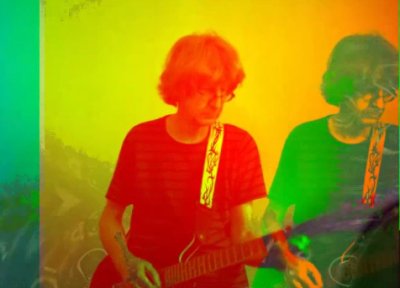
So, the whole year, Patrick & Marc rehearsed and are now ready to play live a set of 27 songs. One third of the set list is from The Sweet Talk repertoire, another third is made of songs by Marc Manara, and the rest is made of covers both of them like to play such as "Under the Milky Way" from The Church or "Cortez the Killer" by Neil Young. A light show has been prepared by Patrick and the playlist continues to grow.
A few private gigs took place already, as well as a gig in a street of Mulhouse for "La Fête de la Musique". Expectedly, the duo will play their material live in the next years.
2003
Patrick, Marc Manara and another friend, JM, start an experimental rock trio. The impulse came from Patrick's old friend JM, who has always been an experimental music buff, keyboards player with sheer adoration for people such as Brian Eno, Robert Fripp and the likes.
JM composed a few tracks of drum machine sequences and keyboard parts - the guy even built his own sequencer. He recorded this in his home studio, and then Patrick added guitars, lyrics, vocals, while Marc Manara added bass lines. The trio then chose the name of IO.
IO rehearsed a number of times at Patrick's home, put together a half dozen pieces that could be played on stage. Some of the pieces were quite long, somehow on the same principles as early Pink Floyd's "Interstellar Overdrive." The IO trio played them in the streets of Mulhouse during the "Fête de la Musique", for two years. The reception was surprisingly positive since the music was quite out of the ordinary as JM is a musician who does not stand to do anything conventional or commercial.
The band also performed once on the open stage of the "Noumatrouff" venue in Mulhouse. The three were very pleased that the odd patterns, ethereal but sometimes rude keyboard parts and guitar shrieking echoes together with the hammering bass lines made a good impression on a generally young public. It was also a great pleasure to hear the sound flow from the powerful sound system of the place. IO had brought their own mixing console and mastered the balance of the instruments themselves from the stage during the show; which permitted a controlled rendition of the pieces.
In a strange way, this was like if The Sweet Talk of 1980 had become a real band: the songs performed live by IO were not very much more conventional than Patrick's music in the 1980's. And it was well-received.
1996
After several rock bands experience that ended when about to deserve a larger success, Patrick felt he should now create his own material, even if he felt there was no perspective of playing them live with a reliable band.
At this time, Patrick managed to buy a second hand 16-track Tascam tape recorder. This was the exact gear on which the "studio album" by The Wood Bees was recorded back in 1982. With a dozen guitars and bases, decent microphones, guitar effects, and such a pro tape recorder, there was no excuse left, something had to be created.
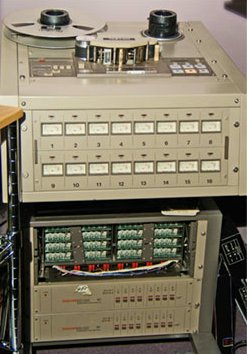
Patrick's Tascam monster.
After an uninspired period, something happened and Patrick composed and recorded six songs in six days. Moreover, he was reasonably satisfied with the songs. This was unexpected as the songs by "Les Autres", mainly composed by the two guitarists whereas Patrick only did the lyrics and vocals, seemed to set an unreachable goal to him. Friends who heard the new songs generally quite liked them.
In the next years, though he had very little free time for music, Patrick continued to create songs which were ultimately gathered on the so-called album "My Haunted Castle".
1993
The new band, "Les Autres", had two sides at first. The composing and recording of the material was smooth and rewarding. The two guitarist brothers and Patrick would meet at Patrick's home and record the songs on Patrick's 8-track Fostex gear. Soon a dozen songs were available. All had marvelous guitar parts, clever bass lines, and the vocals fitted perfectly. It was music unheard in the region, as if it came out of Manchester U-K.
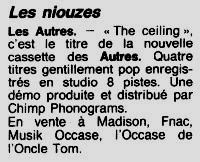
The Press announces the issue
of the cassette tape, 1993.
On the other end, this material was supposed to be played live. The first rehearsal sessions were expectedly a bit frustrating. The band was made of 4 people that fitted together well, but it had become clear that the bass player would never manage to play the bass, so he was elected "treasurer" of the band instead. A few gigs were played, including at a bi party of "Les Jeunesses Ouvrières Catholiques" but it was painfully clear that the songs we recorded deserved a solid and experimented band.
The friend on the keyboard left, feeling that what we were going to perform had nothing of the experimental nonconventional music he would like to play. Eventually, "Arsène" switched from the drums to the bass to replace our debutant bass man, we found a drummer, and everything fit into place from then on.
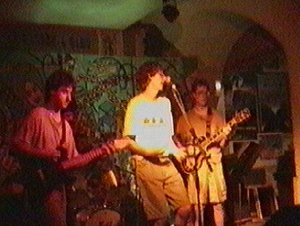
Live at "Le Masque à Jazz", 1993.
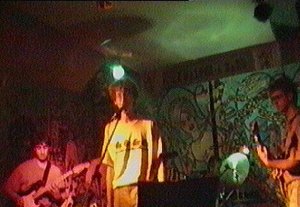
Live at "Le Masque à Jazz", 1993.
"Les Autres" played a number of gigs in the area of Mulhouse. There was not much advertising except for some articles in the regional newspapers, the audience was often sparse, but little by little the concerts were better and better. The band had dropped almost all the covers they performed in the beginnings, and was playing their own material of a score of songs. The jingle jangle of the two guitars rendered well on the quiet songs, nervous rhythms and melodic soloing fitted more nervous songs. Even Patrick's usually low voice would go a bit more high-pitched. Cherry on the cake: Patrick's excellent drummer friend from the time of the Wood Bees joined and the band ended up just excellent. The band played the Noumatrouff venue, the "Palais des Fêtes", several discotheques, pubs in and out of Mulhouse, even a wedding party at "Le Musée de l'Auto", and of course the "Fête de la Musique" every year.
Of course, the band had to split just then, Patrick was going solo again.
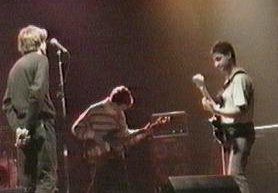
Live at "Le Phoenix", 1993.
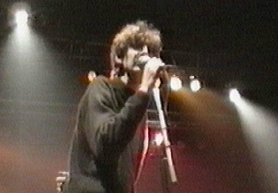
Live at "Le Phoenix", 1993.
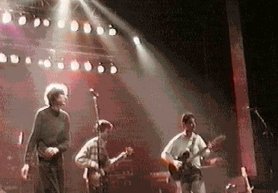
Live at "Le Phoenix", 1993.
1988
In those years, informatics was not yet an essential music tool; it was rather a distraction from music. Patrick had bought his first PC when the first PCs appeared on the French market around 1983, so he changed job, sold computers, then became a software programmer.
The music activity nevertheless started again. With all the friends musicians devoted to their studies, Patrick had formed a band with his brother and cousin. There was no other ambition than to play together in the basement, and the repertoire was essentially made of Beatles, Jacques Dutronc, Serge Gainsbourg covers. Everybody switched instruments from time to time, you would get Patrick playing the drums on a Beatles song then singing a Dutronc song then playing the bass of a Gainsbourg number. The few initial gigs were for the friends at the New Year and birthday parties.
With additional musician joining occasionally, the band played in the streets of Mulhouse for "La Fête de la Musique", tough, under the name "Tonton et les Poires", later to be renamed "Uncle Steed".
Eventually, the band split when Patrick and his brother had an argument about a drum break on a Beatles song: Patrick would argue he knows how it should be played but misses it, while the brother would argue Patrick did not know how the break should be played. This created an amusing situation as Patrick started another competing band.
Patrick's starting of a new band seemed a hopeless attempt at first. He had some experience and was joined by "Arsène" formerly from the Wood Bees who was a capable drummer, but the bass man was a friend who had never touched an instrument, and the other friend who was to play the keyboard was much into experimentation with synthesizers. So the whole formation had a hard time putting some Rolling Stones cover together.
Eventually, "Arsène" brought along a friend: "he plays the guitar, is it alright if he comes along next time?" Sure. The guy actually came with a brother who was also a guitarist. They handed a cassette tape: "some stuff we recorded, there's no singing on it, what do you think of it?" Well, Patrick was flabbergasted. The tracks the two guys did were exactly the kind of music Patrick liked but would have been unable to play. At the next gig, Patrick came back with a tape: he had added the vocals. Everybody agreed, that was something, this is good, we are a real band now. We chose to be called "Les Autres".
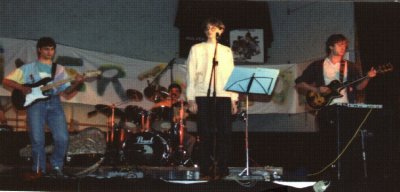
"Les Autres" live in Pulversheim, 1989.
1986
Without a band, or rather, with just the notion that the band could reform some years laters, with no other band he could ever fit in, Patrick, would bought a second-hand four tracks Revox tape recorder, occasionally "produced" other bands, that is, recorded their music in his basement. The hardware was limited, but Patrick had been fiddling with music recording for so many years now that the result was often well above what could have reasonably been expected.
Patrick also started to do his own music. He had bought a bass guitar, an electric guitar, a Korg synthesizer, a Roland drum box, a number of guitar effects pedals. He was barely capable of playing a few chords on the guitar, but had decided to spend time on composing and recording songs rather than on taking guitar lessons. This weird philosophy was not entirely irrational: he had noticed that there were many excellent guitarists around, but the more they played properly, the less they composed anything interesting, if they ever composed anything.
Remember that Patrick had been "doing" music for several years know. With the experience gained in the band, he knew a bit more about things like chords, choruses, tuning a guitar etc. More than once, he had created some drum pattern of the drum box that became an original and interesting drum pattern played by the real drummer of the band.
The first songs by The Sweet Talk met a curious reaction. Patrick's former band mates were usually much amused at the attempts, as the glitches were obvious to them. The songs were frankly, let's say, "psychedelic". They were in the style of nothing heard before, but one could wonder if there would ever be an audience for that. Patrick thought that the audience existed but was unreachable to him. Similarly unconventional music had found an audience, like the strange "Play Blessures" album by Alain Bashung. Or stuff like The Throbbing Gristle in the U-K. But how could a lone clumsy musician from Mulhouse emerge? There was simply no way.
Nevertheless, tiny local fame occurred as some students from the Mulhouse art school who were often at the same pub as Patrick started to listen to the cassette tape recordings. Ultimately, there was even a few gigs, with Patrick alone on stage playing some parts of guitars and singing over a prerecorded tape in from of a small crowd of art school students and the curious. Yes, some pieces by The Sweet Talk like "Daffodils under my pillow" and "Waiting for a parachute" were highly regarded by a few dozen people.
Patrick made only one attempt to get a larger fame: while in London, he dropped a cassette tape on the desks of two alternative record companies: Cherry Red records, and Rough Trade records. He thought it would only be a miracle if any response came, and of course, none came.
1985
The Wood Bees were going nowhere: while Patrick had his schoolteacher job, the guitarist and the drummer were studying in another town. They had practically no free time anymore for rehearsal and gigs. So the band sort of died naturally and peacefully.
Patrick saw no other band he could ever fit in. Most of them played either heavy metal or blues rock or punk rock, whereas The Wood Bees had played their own blend or rock, a weird and quite immature kind of mix between well, the Pink Floyd, the velvet Underground, the Stranglers, the Feelies, the DBs, maybe. There was keyboard in some songs, punkish guitars in others, it was not fitting any of the usual "categories". When the band composed, they would do one kind of song, then another different kind of song, and they would not stick to a defined style or do two songs of the same kind.
So, this was the end of The Wood Bees, and somehow the start of The Sweet Talk.
1984
The band, now called "The Would Be", played gigs in several local halls and bars. It was generally chaotic. Like most local bands then, we did not have our own sound system, and our hardware was generally fragile and insufficient. Once we landed in a village hall where the sound system consisted in two of the thin and tall loudspeakers columns usually found in churches for the priest's preaching. Needless to say, my low voice was often almost not audible over the drums thunder.
Once, the drummer could not be with us at a gig, and we used a borrowed drum machine that sounded quite like "ponk click ponk click..." Of course when the band played, it could not be heard anymore. It was heard again when the song was over and it was almost like a surprise: what was that strange metronome sound? Ah, yes, the drum box.
On another occasion, we were supposed to play in some village hall. It was a terrible winter, with record low temperature unseen in the last decades. We thought we found the hall, parked, and went into a large hall to check out were to disembark our gear. Entering the huge concert hall, the band was awestruck to see a crowd of hundreds of people sitting at tables like for a huge dinner. Most were old people. How could we have gotten such an audience? We usually had between 10 and 50 people attending our gigs, and they were the sort of people... well like us. We saw a huge stage with a huge sound system, went over there, and learned that we were in the wrong hall. This scene was for a regional ballroom band, not for us.
We found "our" concert hall 50 yards away. It was a kind of club house. Nice enough, but the cold hit so hard that everything went wrong. Carrying the metal part of the drum kit inside through 40 cm of snow just froze our hands. The heating system was down. We managed to call and repairman, who was sorry to tell us nothing can be done: the fuel was frozen. We went downtown, managed to borrow a dozen electric radiators that did nothing to heat up the place. We made a sound-check, and found out that the cold just bent the guitar necks so that just in the time to play a song, the tone went lower and lower. Some people had come to see our show, and cheered us up. The band played, packed, fled with most of the audience to Patrick's parents' home, taking refuge in the cellar to drink hot chocolate milk. Some days later, several of our usual fans told me they had made the way to the concert hall but instead of us, a ballroom band was playing in front of a crowd of local elderly. They too, had gone to the wrong place.
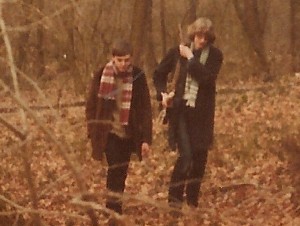
Patrick & Marc Manara:
dreams of rock'n'roll fame, 1984.
Then, Patrick brought his first months of salaries as a schoolteacher to a local sound recording studio: "Hi there, we're a rock band, we want to record our first album". And they did. In a week, recording from 6 p.m. to 1 a..., the band managed to record in professional quality their 10 songs. The only catch was that the normal process is to sign with a record company, then hit the studio, and then sell the record. There was no record company. As there was no way to pay for an LP, we made a self-paid single; which we sold to everyone possible. The minimal quantity you had to order to get it done was 1000. We sold about a third of those, much to our despair - until we learned from other local rock bands that did the same and sold even less.
1983
Then they were three: the band's singer had left, as his parents moved to the other end of the country. A rock band without a singer just made no sense. That's when Patrick decided he would sing. The two others would not sing anyway.
So, the band changed name, becoming "Femme Fatale". Patrick composed lyrics, Marc composed the music, and the whole was recorded by Patrick on the old stereo cassette deck's two internal microphones. That was recording technology for youngster in those years. It was laughable for sure - but the recordings were actually audible enough, so that other local rock bands occasionally asked Patrick for a recording on this very equipment.
Just like he wasn't a decent bass player, Patrick wasn't a decent singer. At school, when the kids had to sing, he let other sing and just moved his lips silently. When he was requested to sing solo, he almost fainted, and the result was quite unconvincing. But with the band, Patrick's concept was to sing low. He had a rather low voice, and when singing low, he did not sound too much out of tune. Best, people were saying it resembled Lou Reed's voice - In the past months, Patrick had made sure everybody heard Lou Reed, and that it was acceptable to sing like that.
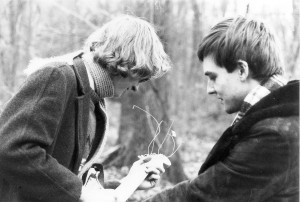
Patrick & Marc, "The Wood Bees".
Soon, a half dozen songs were duly recorded, and Patrick & Marc decided it was time to become rock'n'roll stars. At least, it was time to try and see what happens.
Patrick had discovered that a local pirate radio in Mulhouse calls "Fréquence Mulhouse" was airing French rock, including a local rock bit, where cassette tape recordings of the few rock bands of the Mulhouse area were enthusiastically aired.
So Patrick & Marc went there at the time of the show. They were introduced in the studio, they handed their cassette tape, a first song was aired and apparently made and impression, as it continued with a live interview and the airing of the entire cassette tape.
The two guys who hosted the show were nice, and hip. They knew much about rock music, with a taste for unadulterated garage rock and high energy rock, Shockabilly fans. They particularly liked one of our song, a weird punkish hyper fast piece with saturated guitar and tons of echoes. They would play the tape in the next shows again, while I would join the pirate radio team and host a weird esoteric psychedelic rock show called "Le Livre des Cranes" on Saturday nights for the two next years. It ended when, after being legalized, the radio station frequency was literally stolen from us by a local commercial radio.
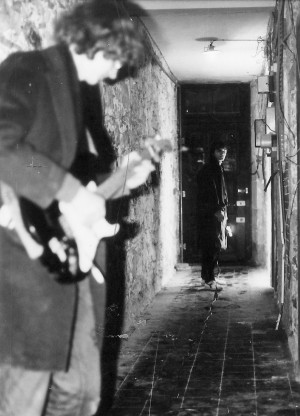
Patrick & Marc in the actual hall of the pirate radio.
Before, a guy from the radio joined the band. Patrick being unable to play the bass and sing at the same time when the bass line was not simple enough to play, so the band needed a fourth player to go on stage. "Arsène" was a bit older than us and had played in local rock bands more than a decade. Patrick is still friends with the chap who still plays the bass in local rock bands.
1979
A few years earlier, Patrick saw that his friend Marc was the owner of an electric guitar and an amplifier. At first, Patrick was quite amazed: what the hell id an electric guitar exactly? How does it work? Does "electric" mean that you press a button and it plays a tune? But very quickly, the decision was made: Patrick wanted an electric guitar too. This was a hard fight. His mother decided that an electric guitar is out of the question. Such a device must be a devilish thing: it makes an awful noise, it drags young people to the bad tracks of hippyism hence drugs and sexual misconduct.
While Patrick was hopelessly making his argument for getting an electric guitar for Christmas, things were happening on Marc's side. At high school, Marc befriended with students who were in the official high school rock band. With the drummer and another boy, they started to rehearse at the drummer's basement. They even composed their own material. Marc strummed his guitar, soloed, drummer JN demonstrated his already talented drumming, and the other youngster sung.
Patrick quickly noticed that something was missing: no bass player. So he decided that he does not need an electric guitar anymore. He needs an electric bass guitar, guaranteed to grant him a place in the band. When he finally managed to drag his mother into a music instruments shop, and played some notes on a bass guitar there, his mother almost collapsed. She was absolutely unable to even understand the purpose of an instrument that produced only low "boom boom" sounds. The consequence was that she so firmly refused to buy Patrick and electric bass guitar that they came out of the shop with an electric guitar.
Fortunately, Marc permitted Patrick to use his bass guitar and join the band. This is how it really started, and it was a quite painful start: the bass guitar hurt Patrick's fingers very much. It was more difficult than expected to play in a band. Remembering the fingers position to perform a bass line, playing in rhythm, this would take years to Patrick.
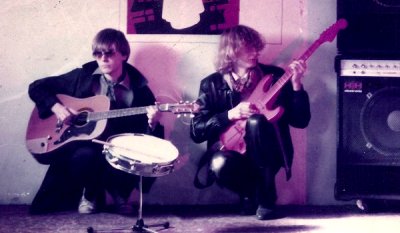
Patrick & Marc Manara, 1982.
1978
Patrick attends high school in Mulhouse. He realizes that a proportion of people of his age are into rock music, talking about new issues, exchanging and taping LPs. He discovers, across the high school street, the public library. Of course, he read hundreds of books, discovered Philip K. Dick, but also, the public library had a sizeable record collection with tons of rock LPs. Patrick registered, and made cassette tapes of almost the entire collection, something like 500 cassette tapes. Patrick listened to all the classic rock, prog rock, but also discovered a number of rock bands that nobody talked about, who produced music that immensely appealed to him: The Velvet Underground, Television, The New York Dolls. Patrick remembers, for example, being the sole student who was talking about "Syd Barrett", claiming "I know where he lives" to anybody who vaguely seemed to care. Nobody except his buddy Marc who was in another high school seemed to know who Syd Barrett was.
The only thing missing at high school was that there was no rock band at all. Most students were listening to rock music - some indulged in disco and silly pop music, though - but nobody seemed to play any instruments od play in a rock band. The very idea of being in a rock band seemed non-existent. But it existed in Marc's high school...
1976
Patrick had been very remote from every pop or rock music in his childhood. He used to listen to a pile of classical records ranging from Beethoven, Mendelsohn, Chopin, Rimsky Korsakov and the likes. The French pop music he occasionally heard on the radio did not appeal to him at all. In these years, for a young schoolboy or teenager, rock music simply did not exist. The few national TV channels produced almost no rock show. It produced French popular music shows featuring people like Dalida, Claude François, Sacha Distel. They sung boring love songs or silly songs along with music played by "orchestras" that played simple and conventional "arrangements" that did not get Patrick's attention.
Patrick remembers his first contact with the world of rock music: reading the news magazine "L'Express", he came upon a several pages long article about a rock band name "The Rolling Stones". The article told their story, and introduced the band as a group of "bad boys" but with an extraordinary talent for music and quite clever-minded. The article explained how, together with other rock bands, they had an extraordinary influence on the entire society Rock bands created an entire new culture, Patrick learned. Though at this time he had never even heard any music from the Rolling Stones, he suspected there was something to it.
Not much later, one evening, he was at the home of his best friend - whom we will call "Marc Manara". The two met when they entered primary school in Riedisheim and had much in common, such as building planes model kits. Anyway, that evening, Marc had turned on the TV set, announcing that a concert by The Rolling Stones was being broadcast. Patrick was quite taken by what he heard and saw. He had just discovered that rock music was to play a big part in his life.
Marc, who had discovered rock music much sooner, provided Patrick with cassette tapes of The Pink Floyd, King Crimson, Status Quo, the Beatles and so on. Patrick had been fortunate enough to get a stereo cassette player on Christmas, and started his cassette tapes collection.
1972
Patrick's brother hums symphonies all the time, so he gets to attend the Music School of Mulhouse where he studies the violin. In the next decades, he becomes a virtusoso and gets a PhD in musicology. He become a professional music teacher and orchestras member, bur also a member of many rock bands. In the meantime, he fills the house with violin sounds 2 hours a day at least. Patrick is into drawing and painting.
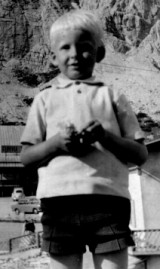
Patrick in 1968.
1966
Patrick's brother is born. Oddly maybe, it was quickly decided that Patrick must be gifted for visual arts, drawing and painting, whereas his brother must be a born musician. The years to come seemed to prove this was true, at first.
1963
Patrick is born in Mulhouse, Alsace, France.
The family moves to Riedisheim, next to Mulhouse, where Patrick enters kindergarten, then primary school where he immediately befriends future musician and best friends "Marc Manara".